
Advanced Econometrics with EViews and R

- Description
- Curriculum
- FAQ
- Reviews
- Grade
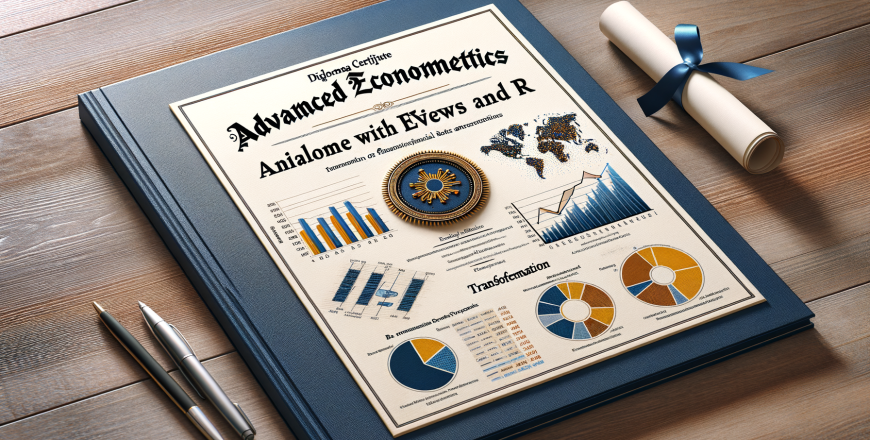
Diploma in Advanced Econometrics with EViews and R
Enhance your econometric expertise by mastering EViews and R, powerful tools for converting financial data into valuable insights.
Course Overview:
- Introduction to Advanced Econometrics
- Understanding Data Structures in EViews and R
- Exploratory Data Analysis Techniques
- Regression Models and Forecasting
- Time Series Analysis using EViews
- Statistical Inference and Hypothesis Testing
- Panel Data Analysis with R
- Machine Learning Applications in Econometrics
- Project Work and Case Studies
Course Benefits:
- Gain proficiency in EViews and R for econometric analysis
- Learn to interpret and communicate complex financial data effectively
- Develop practical skills in regression analysis and time series forecasting
- Apply machine learning techniques to real-world econometric problems
- Enhance your resume with a valuable diploma in Advanced Econometrics
Who Should Enroll:
This diploma is ideal for finance professionals, economists, researchers, and students looking to advance their data analysis skills in the field of economics and finance.
Prerequisites:
Basic knowledge of econometrics, statistics, and programming concepts is recommended for this course.
Language:
The course will be conducted in English (en_US).
Join us on this dynamic journey to harness the power of EViews and R in transforming financial data into actionable insights!
-
1
 Econometrics Fundamentals
Econometrics is a branch of economics that applies statistical methods to analyze economic theories and test hypotheses. It plays a crucial role in understanding and predicting economic trends, making informed policy decisions, and evaluating the effectiveness of various economic policies. By studying econometrics fundamentals, one can learn how to collect and analyze economic data, build and test economic models, and draw meaningful conclusions from empirical evidence. Mastering these fundamentals is essential for any economist or policy analyst looking to make evidence-based decisions in today's complex and dynamic economic environment.
-
2
 EViews Software Overview
EViews is a powerful statistical software package used for econometric analysis. It provides tools for data management, regression analysis, time series forecasting, and more. With a user-friendly interface and comprehensive features, EViews is widely used in academic research, government agencies, and businesses. Its advanced capabilities allow users to perform complex econometric modeling and analysis with ease. EViews supports various data formats and offers extensive customization options for generating reports and graphs. Overall, EViews is a versatile tool for conducting empirical research and analyzing data in economics, finance, and related fields.
-
3
R Programming Basics
R Programming Basics
Learn the fundamental concepts of R programming with this comprehensive guide. Explore the basics of data types, variables, functions, and control structures in R. Understand how to manipulate and analyze data using R's powerful tools and libraries. Enhance your programming skills and gain a solid foundation in statistical computing with R.
-
4
 Assignment 1
-
5
Simple Linear Regression
Simple Linear Regression
Simple linear regression is a statistical method used to model the relationship between two variables. In this technique, one variable is designated as the independent variable, while the other is the dependent variable. The goal is to find a linear relationship between the two variables, represented by a straight line on a graph. This method is commonly used in various fields such as economics, finance, and social sciences to predict and understand the behavior of one variable based on the other. Simple linear regression is a fundamental tool in data analysis and predictive modeling.
-
6
Multiple Regression Models
Multiple regression models are a statistical technique used to analyze the relationship between a dependent variable and two or more independent variables. This method allows for the identification of the individual effect of each independent variable on the dependent variable, while controlling for the effects of other variables. By incorporating multiple factors into the analysis, researchers can better understand the complex interactions that influence outcomes. Multiple regression models are commonly used in various fields such as economics, psychology, and social sciences to make predictions and inform decision-making processes.
-
7
Model Interpretation in EViews
Model interpretation in EViews is crucial for understanding the relationships and dynamics within your data. EViews provides tools and features to help you interpret your model results effectively. By analyzing coefficients, significance levels, and diagnostic tests, you can gain valuable insights into the factors driving your data. Having a clear understanding of your model interpretation can guide decision-making and improve the accuracy of your predictions. Take advantage of EViews' capabilities to enhance your analysis and make informed decisions based on your model results.
-
8
Assignment 2
-
9
Stationarity and Seasonality
Stationarity and seasonality are important concepts in time series analysis. Stationarity refers to a time series that does not exhibit any trends or systematic patterns over time. Seasonality, on the other hand, refers to regular and predictable fluctuations in a time series that occur at specific intervals. Understanding stationarity and seasonality is crucial for accurately modeling and forecasting time series data. By identifying and addressing these characteristics, analysts can improve the accuracy and reliability of their predictions. Properly accounting for stationarity and seasonality can lead to more informed decision-making and better outcomes in various industries.
-
10
ARIMA Models
ARIMA models, or Autoregressive Integrated Moving Average models, are widely used in time series analysis to forecast future values based on past observations. These models combine the concepts of autoregression (AR), moving average (MA), and differencing (I) to capture the linear dependencies within a time series. By fitting the model to historical data, ARIMA models can provide valuable insights into trends and patterns that can be used to make informed decisions. Understanding the principles behind ARIMA models and how to apply them effectively is essential for accurate forecasting and decision-making in various industries.
-
11
Forecasting Techniques in EViews
Forecasting Techniques in EViews are essential for predicting future trends and making informed decisions. EViews offers a variety of advanced methods such as ARIMA, VAR, and GARCH models to analyze time series data and generate accurate forecasts. By utilizing these techniques, users can gain valuable insights into market dynamics and optimize their strategies for success. Stay ahead of the competition with EViews forecasting capabilities.
-
12
Assignment 3
-
13
Panel Data Analysis
Panel Data Analysis involves examining data collected over time from a group of individuals or entities. This method allows for the analysis of both cross-sectional and time-series data, offering a comprehensive understanding of trends and relationships. By considering individual characteristics alongside time-based factors, Panel Data Analysis provides valuable insights for decision-making and policy formulation. This approach is especially useful in economics, social sciences, and market research. Understanding how to conduct Panel Data Analysis can enhance the quality of research and contribute to the development of effective strategies.
-
14
Simultaneous Equations Models
Simultaneous Equations Models are a commonly used statistical method in econometrics to analyze relationships between multiple variables. These models involve a system of equations where each equation includes multiple variables and their coefficients. By solving these equations simultaneously, researchers can estimate the relationships between the variables and make predictions about their behavior. Simultaneous Equations Models are particularly useful for studying complex economic systems and understanding how different factors interact with each other. This method is widely used in various fields such as economics, sociology, and political science to gain insights into the relationships between variables.
-
15
Heteroskedasticity and Autocorrelation
Heteroskedasticity and autocorrelation are two common issues in statistical analysis. Heteroskedasticity refers to the situation where the variability of the error term is not constant across observations, violating the assumption of homoscedasticity. Autocorrelation, on the other hand, occurs when error terms in a time series are correlated with each other, leading to biased and inefficient estimates. Both problems can have serious implications for the validity of statistical tests and the reliability of results. It is important to address these issues through appropriate modeling techniques and diagnostic tests to ensure the accuracy and robustness of statistical analysis.
-
16
Assignment 4
-
17
R Data Structures
R Data Structures are essential for organizing and storing data efficiently in R programming. Understanding the different types of data structures such as vectors, matrices, data frames, and lists is crucial for successful data manipulation and analysis in R. By choosing the appropriate data structure for your data, you can optimize performance and enhance the readability of your code. Familiarizing yourself with R data structures can greatly improve your data analysis skills and make your code more robust and efficient.
-
18
R Data Manipulation
R data manipulation is a crucial aspect of data analysis and statistical modeling in the field of data science. By utilizing various functions and packages in R programming language, researchers and analysts can efficiently clean, transform, and manipulate large datasets to extract valuable insights and make informed decisions. Some commonly used packages for data manipulation in R include dplyr, tidyr, and reshape2. These tools provide a wide range of functions for filtering, sorting, merging, and summarizing data, making it easier for users to perform complex data manipulation tasks with ease and accuracy.
-
19
R Data Visualization
Data visualization in R is a powerful tool for analyzing and presenting complex data sets. With various packages such as ggplot2 and plotly, users can create highly customizable and interactive plots that aid in understanding patterns and trends within the data. By visualizing data, researchers and analysts can easily communicate their findings to stakeholders and make informed decisions. R's flexibility and ease of use make it a popular choice for data visualization among professionals in various industries. Utilizing R for data visualization can greatly enhance the efficiency and effectiveness of data analysis processes.
-
20
Assignment 5
-
21
Modeling Economic Data in R
Modeling Economic Data in R is essential for analyzing and predicting economic trends. R is a powerful tool that allows for advanced statistical analysis and visualization of economic data. By utilizing R's capabilities, researchers and analysts can better understand complex economic relationships and make informed decisions. Whether you are studying macroeconomic indicators or analyzing market trends, R provides the tools needed to create accurate and reliable models. With its wide range of packages and functions, R is an invaluable resource for anyone looking to delve into economic data analysis.
-
22
Regression Analysis in R
Regression analysis is a powerful statistical technique used to study the relationship between variables. In R, a popular programming language for statistical computing, regression analysis is commonly performed using the lm() function. This function allows users to fit linear models to their data and extract insights such as the strength and direction of relationships between variables. By conducting regression analysis in R, researchers can uncover patterns, make predictions, and draw meaningful conclusions from their data. Understanding how to use regression analysis in R can greatly enhance data analysis and decision-making processes.
-
23
Advanced Visualization in R
Advanced Visualization in R allows users to create complex and informative plots to enhance data analysis. With a wide range of tools and packages available, R enables users to generate visually appealing charts, graphs, and interactive visualizations. By leveraging advanced techniques such as ggplot2 and Plotly, users can create customized visualizations that effectively communicate insights from their data. Whether you are a beginner or an experienced R user, advanced visualization capabilities in R can help you better understand and present your data.
-
24
Assignment 6



- Course Name: Diploma in Advanced Econometrics with EViews and R
- Duration: 12 weeks
- Instructors: Experienced Econometricians
- Software Used: EViews, R
- Level: Advanced
- Basic knowledge of econometrics
- Proficiency in statistical analysis
- Access to a computer with EViews and R installed
- Familiarity with data manipulation techniques
- Understanding of regression analysis
- Econometrics students seeking advanced skills
- Financial analysts looking to enhance data analysis techniques
- Researchers aiming to apply econometric methods in their work
- Professionals in banking and finance
- Graduates wanting to specialize in econometrics



 Google